

How it would work
Evidence, diagnosis, dialogue and follow-through.
The proposed approach would examine whether governance guardrails operate in practice, then support institutional learning without assuming government powers.
A seven-stage engagement process
1. Entry
Agree scope, authority and safeguards.
Agree scope, authority and safeguards.
2. Orientation
Understand mandate and context.
Understand mandate and context.
3. Evidence
Gather documents and operational evidence.
Gather documents and operational evidence.
4. Diagnosis
Apply the GGDF.
Apply the GGDF.
5. Dialogue
Test findings with responsible actors.
Test findings with responsible actors.
6. Improvement
Develop practical corrective actions.
Develop practical corrective actions.
7. Follow-through
Monitor whether changes endure.
Monitor whether changes endure.
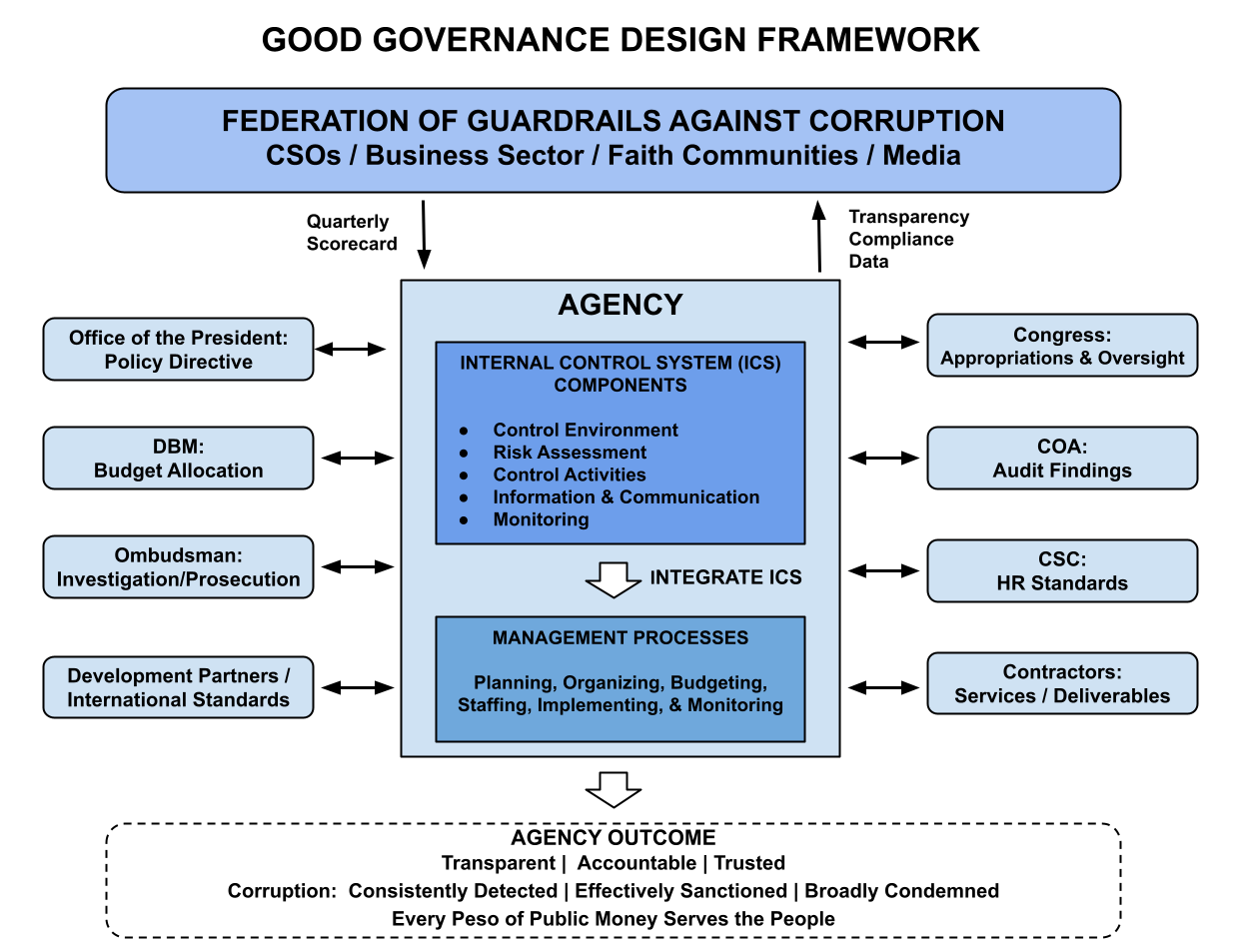
The GGDF
The Good Governance Design Framework would organize examination of how an agency directs, controls, monitors and corrects its own conduct. It distinguishes the presence of formal requirements from their reliable operation.
The detailed methodology remains subject to expert review, piloting and refinement.
What an engagement would not be
Not an investigation
A future FGAC would not exercise prosecutorial or police powers.
Not a statutory audit
It would not displace the Commission on Audit or authorized government reviewers.
Not a political scorecard
The methodology would need evidence standards, due process and institutional safeguards.